
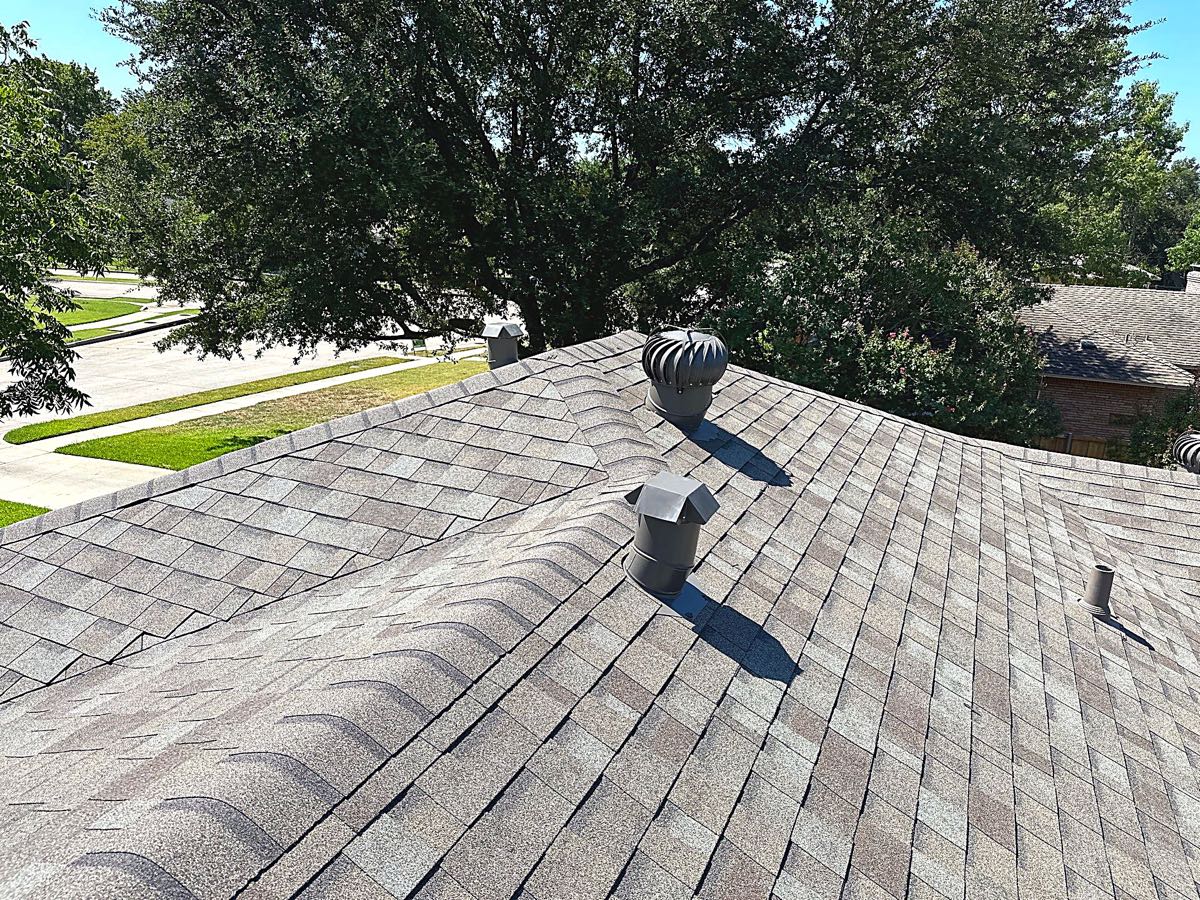
What does poor attic ventilation actually look like?
Most homeowners don't think about their attic until something else tips them off. Here's what to watch for:
- Upstairs rooms that stay hot even when the air conditioner is running hard.
- Shingles that look curled, cracked, or are shedding granules years before they should.
- Rusty nails or fasteners visible in the attic, a sign moisture is getting trapped too.
- A musty smell when you open the attic hatch.
- An energy bill that jumps hard from May through September compared to other months.
One or two of these on their own aren't proof of anything. Several at once, especially on an older Garland or Dallas home, is worth a closer look.
How hot does a North Texas attic really get?
On a typical summer day here, a poorly ventilated attic can run well over 130 degrees because there's nowhere for the hot air to go once it collects under the roof deck. That heat radiates down through the ceiling into the rooms below, and it also sits directly under your shingles, softening the asphalt from the inside for hours at a stretch. A well-vented attic still gets hot in July, but it stays much closer to outside air temperature instead of turning into a heat trap.
Why the heat matters for your shingles
Asphalt shingles are built to handle heat from the sun side. What shortens their life is heat from both directions at once. When the attic underneath stays hot for months, the adhesive strips and asphalt mat soften repeatedly, and the shingles curl at the edges, crack, and lose granules faster than the manufacturer's rated lifespan assumes. It's a slow process, which is why it's easy to miss until a roof that should have another decade left starts failing early.
Ridge vents, soffit vents, and why you generally need both
Ventilation only works as a system. Soffit vents under the eaves pull in cooler outside air low on the roof. A ridge vent or gable vents up top let the hot air escape as it rises. One without the other doesn't move air the way the roof needs.
| Vent type | Role | Common issue |
|---|---|---|
| Soffit vents | Intake, pulls in cooler air along the eaves | Blocked by insulation packed against the eave |
| Ridge vent | Exhaust, continuous vent along the roof peak | Installed with no matching intake below |
| Gable vents | Exhaust at the peak of a gable wall | Can short-circuit a ridge vent if both are open |
| Powered attic fan | Forces exhaust with a motor | Can pull conditioned air from the house if intake is weak |
Most building codes call for roughly one square foot of vent opening for every 150 square feet of attic floor space, split between intake and exhaust. On an older Garland or East Dallas home that's had insulation added or a partial reroof over the years, it's common to find that ratio thrown off in one direction or the other.
Does this affect my shingle warranty?
It can. Most major shingle manufacturers list minimum attic ventilation as a condition of their material warranty, right alongside proper installation. If a roof develops premature curling or cracking and the attic underneath turns out to be poorly vented, that can complicate a warranty claim. It's one more reason to have ventilation checked as part of any roof repair, not just assume a shingle failure is bad luck.
Repair, upgrade, or replace?
If your shingles are still in reasonable shape, clearing blocked soffit vents, adding baffles, or installing a ridge vent is usually enough on its own. If the heat has already done its damage, shingles that are cracked, brittle, or missing granules across large sections point toward a roof replacement instead, ideally with the ventilation corrected at the same time. Our guide on the best shingles for Texas heat covers which materials hold up best once ventilation is handled.
What this means for your energy bill
A hot attic doesn't stay contained to the attic. That heat radiates through the ceiling into the rooms below, so your air conditioner runs longer and harder to keep up, especially upstairs. Correcting the airflow won't replace good insulation or a properly sized AC system, but it takes real pressure off both during the stretch from late May through September when North Texas attics see their worst heat.
If you're not sure whether your attic is part of the problem, we check ventilation as a standard part of every free roof inspection we do for homeowners in Garland and across the DFW metroplex. We'll tell you plainly whether a repair fixes it or the roof itself needs attention.